Get in touch !
Fill out your information we will contact you!



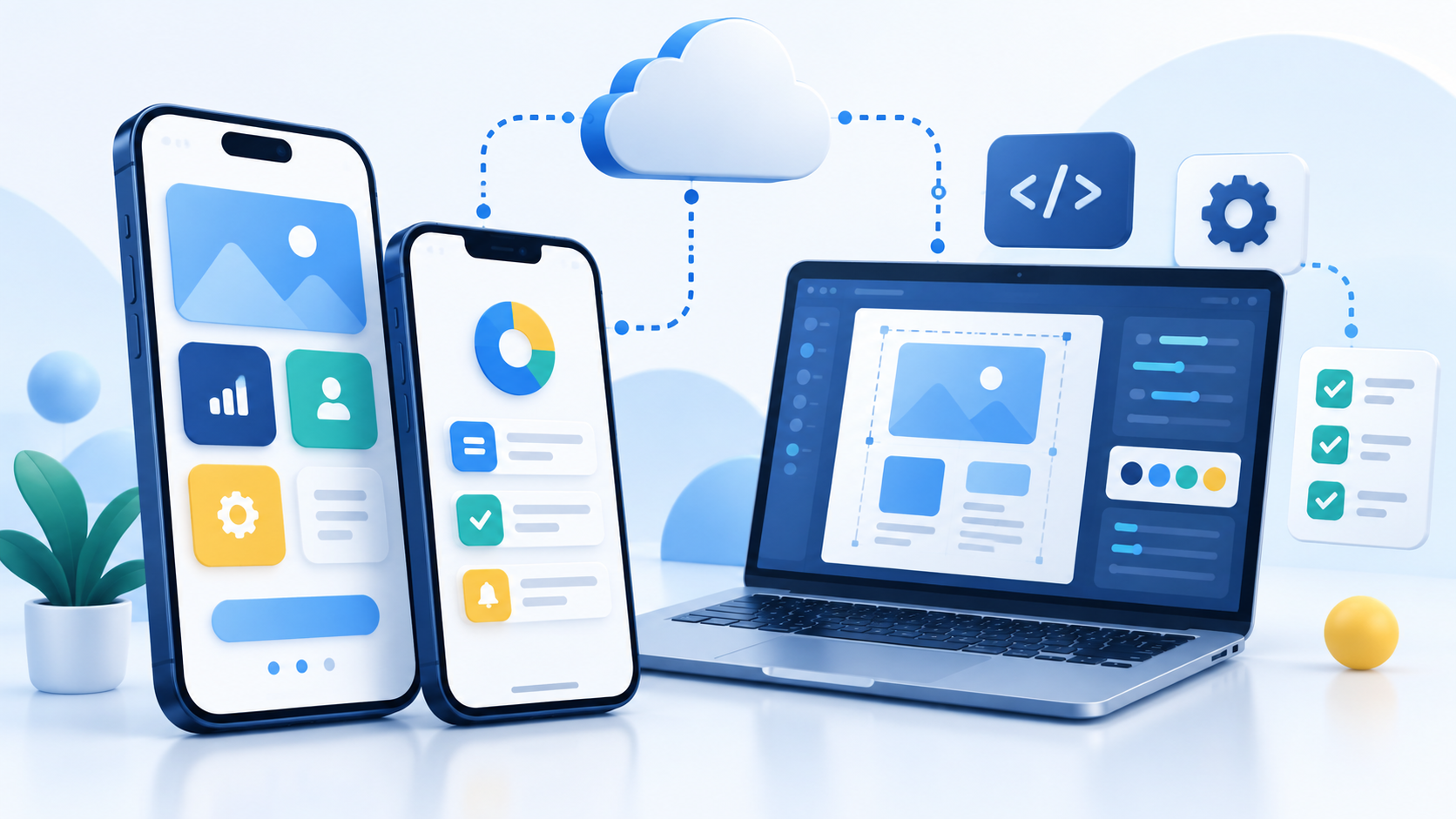
Customers and employees increasingly use smartphones for communication, transactions, services and day-to-day work. For many businesses, a mobile application can provide a direct and convenient way to connect users with products, services or internal processes.
A well-planned mobile app is more than a smaller version of a website. It should be designed around mobile behaviour, simple navigation, performance, security and the specific task a user wants to complete.
Custom mobile app development is the process of designing and building an application around the specific requirements of a business or organization. Instead of adapting operations to a generic application, the product is planned around required users, workflows, integrations and business goals.
Custom applications may be customer-facing, employee-facing, partner-facing or designed for a specific operational process.
Android has a broad device ecosystem and is an important platform for businesses targeting mobile users. Android applications can be developed for customer services, sales, field operations, ordering, internal workflows and many other use cases.
Development decisions should consider supported devices, operating-system versions, performance, security and the required backend integrations.
Businesses targeting iPhone and iPad users may require a dedicated iOS application. Native iOS development can provide close integration with Apple platform capabilities and a user experience designed specifically for iOS devices.
The right approach depends on the target audience, required functionality, budget and long-term product roadmap.
Cross-platform frameworks can allow teams to build applications for more than one mobile platform while sharing significant parts of the codebase. Technologies such as Flutter and React Native are commonly considered for this type of development.
Cross-platform development can be useful for many business applications, but the technical choice should be made after reviewing performance requirements, device features, integrations and future maintenance needs.
Mobile apps can support a wide range of business processes. Examples include sales-force applications, customer-service apps, order-taking systems, field-service apps, dealer or distributor portals, booking applications, internal approval workflows and reporting dashboards.
The best use case is one where mobile access removes friction from an existing customer or operational workflow.
Mobile users expect clear navigation and fast access to important actions. UI/UX design should therefore focus on simple screens, readable content, touch-friendly controls and logical user journeys.
Prototypes and interface designs can help stakeholders validate the user flow before full development begins.
Many mobile applications need to communicate with a server, database, ERP, CRM, payment system or another business platform. APIs provide the connection between the mobile interface and these backend services.
Integration planning is important because the app’s reliability often depends on how securely and efficiently data is exchanged with other systems.
Business applications may handle customer information, transactions or internal company data. Authentication, authorization, encrypted communication, secure storage and appropriate backend controls should be considered during system design.
Security requirements should be evaluated according to the sensitivity of the data and the risk profile of the application.
A mobile application may behave differently across devices, screen sizes, operating-system versions and network conditions. Testing should cover important user journeys, validation rules, API interactions, performance and failure scenarios.
Quality assurance before release can reduce avoidable issues and improve the user experience.
Once development and testing are complete, the application needs to be prepared for distribution. Public consumer apps may be released through relevant app stores, while some business applications may use controlled or private distribution methods.
Store policies, signing requirements, privacy information and release assets should be prepared as part of the deployment process.
Mobile development does not end at the first release. Operating systems, devices, APIs and business requirements continue to change.
Regular maintenance can include bug fixes, compatibility updates, performance improvements, security updates and new functionality based on evolving business needs.
Native development can be appropriate when an application requires deep platform integration, highly platform-specific behaviour or demanding performance. Cross-platform development can be attractive when a business wants to serve Android and iOS users with greater code reuse.
There is no single correct choice for every project. The decision should be based on functionality, target users, timeline, budget, performance expectations and long-term maintenance.
Custom mobile applications can be useful across retail, wholesale, distribution, healthcare, education, logistics, transport, hospitality, manufacturing, professional services, e-commerce and many other industries.
The application should solve a clear business or user problem rather than being created only because mobile apps are popular.
A structured project commonly begins with requirement discovery and business analysis. This is followed by user-flow planning, UI/UX design, architecture and technology selection, development, integration, testing and deployment.
After launch, analytics, feedback and operational experience can guide future improvements.
A professional development team can help translate a business requirement into a technical solution, identify integration needs, select an appropriate architecture and plan testing and deployment.
Businesses should evaluate a development partner on technical capability, communication, understanding of the business process, quality practices and post-launch support rather than selecting only on initial development cost.
Businesses searching for a mobile app development company in Patna or Bihar can evaluate Dynode Software for custom software, web and mobile application requirements.
Dynode’s public website describes expertise in web and mobile solutions and references mobile technologies and platforms including Android, iOS, Swift, Kotlin, Java, Flutter, Xamarin, Ionic and React Native.
A successful mobile application begins with a clear problem and a well-defined user journey. Technology should then be selected according to the users, features, integrations, security requirements and future roadmap.
Whether a business needs an Android app, an iOS application or a cross-platform solution, a structured development process can help turn the requirement into a maintainable digital product that supports real business objectives.
Mobile app development is the process of planning, designing, building, testing and maintaining applications for smartphones, tablets and other supported mobile devices.
Native apps are developed specifically for a platform such as Android or iOS. Cross-platform applications use frameworks that can share code across multiple platforms.
Yes, when the existing system provides suitable APIs or integration mechanisms. The exact integration depends on the architecture and security requirements of both systems.
The best technology depends on the project. Factors include target platforms, required device features, performance, integrations, development timeline and long-term maintenance.
Not always. The decision should be based on the devices used by the target audience and the business requirements.
Dynode Software Technology Pvt. Ltd. provides software, web and mobile application development services from Patna, Bihar.
Dynode Software Technology PVT. LTD.
Reg. Address : 203, Jyoti Tower, New Dak Bunglow Road, Infront of Central Bank, Patna - 800001, Bihar
Work Address : Mahaveer Path, New Bangali Tola
Near Uma Niwas, Infront Of Aryabhatt Knowledge University,
Mithapur Bus Stand Area, Patna - 800020, Bihar
Office: +91-7979078552
Email: corp@dynodesoft.com
Website: https://www.dynodesoft.com/
Reg. Address : 203, Jyoti Tower, New Dak Bunglow Road, Infront of Central Bank, Patna - 800001, Bihar
Work Address : Mahaveer Path, New Bangali Tola
Near Uma Niwas, Infront Of Aryabhatt Knowledge University,
Mithapur Bus Stand Area, Patna - 800020, Bihar

